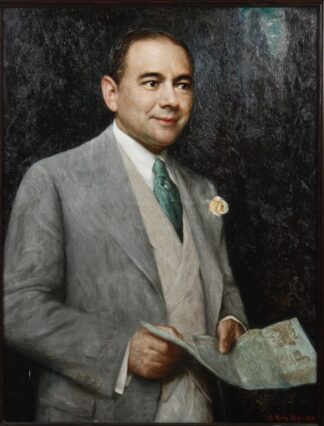
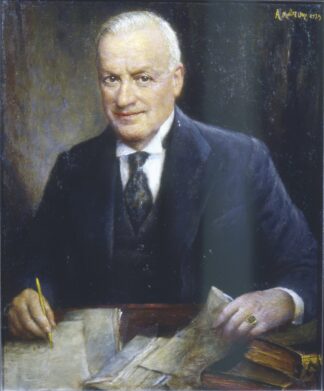
Description
The sitter was born on July 12, 1840 and was a New York department store owner and art collector who is best known today for his large art collection, which he donated to the Metropolitan Museum of Art. He was the son of Bavarian Jews who emigrated to America in 1835 and who opened a small store on Attorney Street in New York City. After working in his father’s dry goods store, Altman set out on his own. In 1865, Altman founded B. Altman & Co., a dry goods store located on Third Avenue and Tenth Street in New York. The company continued to prosper and expanded to several other locations. In 1877, he opened a new store on Sixth Avenue which eventually encompassed the whole city block.
Benjamin Altman was an avid collector of paintings by Rembrandt and Netherlandish and Dutch masters, Italian Renaissance paintings and Oriental porcelain, much of which he acquired through his friend, art dealer Henry J. Duveen, to whom he spoke in Yiddish. The painting collection alone was notable for including a Vermeer and some twenty paintings by or attributed to Rembrandt, all of which, after he died on October 7, 1913, were bequeathed to the Metropolitan Museum of Art to be kept together in galleries set aside for them alone.
—
Muller-Ury was commissioned to paint Benjamin Altman from the only two photographs in existence of him in October 1913 with a view to the picture being presented to the Metropolitan Museum. A letter from Dr. B. Sachs, written from 555, Park Avenue, New York on October 13, 1913 (artist’s papers) is relevant to this:
‘My dear Mr. Ury:-
I have taken the liberty of asking Mr. Friedsam & several other friends of Mr. Altman to come to your studio Thursday at four o’clock to see the Morgan portrait. If this is convenient to you, no answer will be required. – I shall take great pleasure in sending you a copy of my address on my dear friend.
Sincerely yours, B. Sachs.’
The trustees must have liked what they saw for the artist began a portrait of Altman. The almost completed picture was described as stated above in American Art News, December 13, 1913, and added ‘It is a rarely dignified presentment, an excellent likeness and a thoroughly good work of art as well.’
Why the artist made two different pictures of the collector is unknown.
Perhaps there was some hesitancy on the part of the Altman Estate executors in sending the first of the artist’s pictures to the Metropolitan Museum, and so he created a simpler version. Whatever the sequence of events, on July 23, 1914, Michael Friedsam wrote to the artist as follows (same source):
‘Dear Mr. Muller-Ury:-
Your letter of the 17th inst. was duly received, and, in reference to the portraits of the late Mr. Altman, made by you, I wish to state that, if you will kindly communicate with Mr. Hobby at the Metropolitan Museum of Art, he will be pleased to make an appointment with you to talk the matter over.
Very truly yours, M. Friedsam.’ Mr. Hobby was Theodore Y. Hobby, Altman’s personal secretary, a rather staid and unimaginative man by all accounts, who ended up as the curator of the Altman bequest to the Metropolitan Museum. It is worth noting here the fact that in his letter Friedsam refers to ‘portraits’, and it is interesting that neither of the two that survive, including this one, was accepted by the executors for the museum, though Friedsam did present a third portrait to the Chamber of Commerce in 1925. By September 1914 Muller-Ury’s portrait was announced as not going to the Metropolitan Museum and a rather dull stiff picture by Ellen Emmet Rand was accepted by the Altman trustees for the Museum instead.
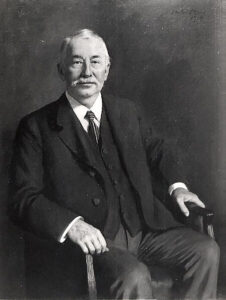
A financial statement in the Knoedler Library dated November 4, 1915 (Domestic Letterbook September 1, 1915—November 5, 1915, No. 490), a rare survival, indicates that the dealers charged Muller-Ury $15.00 for repairing and restretching a portrait of Altman and $22.00 for repairing the frame on September 21, 1914.
An anonymous cutting (artist’s papers) indicates that the artist refused to make some changes requested by the Trustees (unspecified) and so his portrait was hung in the Executive Boardroom of the Altman Foundation on Fifth Avenue, which an undated fragment of a letter (same source) indicates:
‘…I am glad to know that the Altman portrait has finally been settled and believe you will be pleased with the position that has been given it in the Foundation Room.
Very sincerely yours, B. Sachs.’
For such an important commission it is surprising that no photograph of the work was amongst the artist’s papers or with the Altman Foundation itself. Further, the Altman Foundation offices, which were once inside the B. Altman & Company store building on Fifth Avenue – because when Benjamin Altman died in 1913 at the age of 73 his stock in the company was placed in this foundation – was forced to close in 1985 due to a change in IRS rulings, and the foundation then sold the Fifth Avenue store and all the branches elsewhere to an investor group and moved out. Curiously, what must have been a rather distinctive Muller-Ury portrait of their founder was not transferred to the new offices. The second portrait with the simpler background catalogued here as No 2, presumably hung elsewhere in the store until 1985, though there is no correspondence about the work or where it was sent. Sachs and Friedsam both had their portraits painted by Muller-Ury in 1915 and 1927 respectively, so there was clearly an admiration for the artist’s work, and evidently both Altman portraits remained in the building when, after 1985, the premises were sold, and so ended up in the possession of the present owner.